English Proficiency Test Adalah
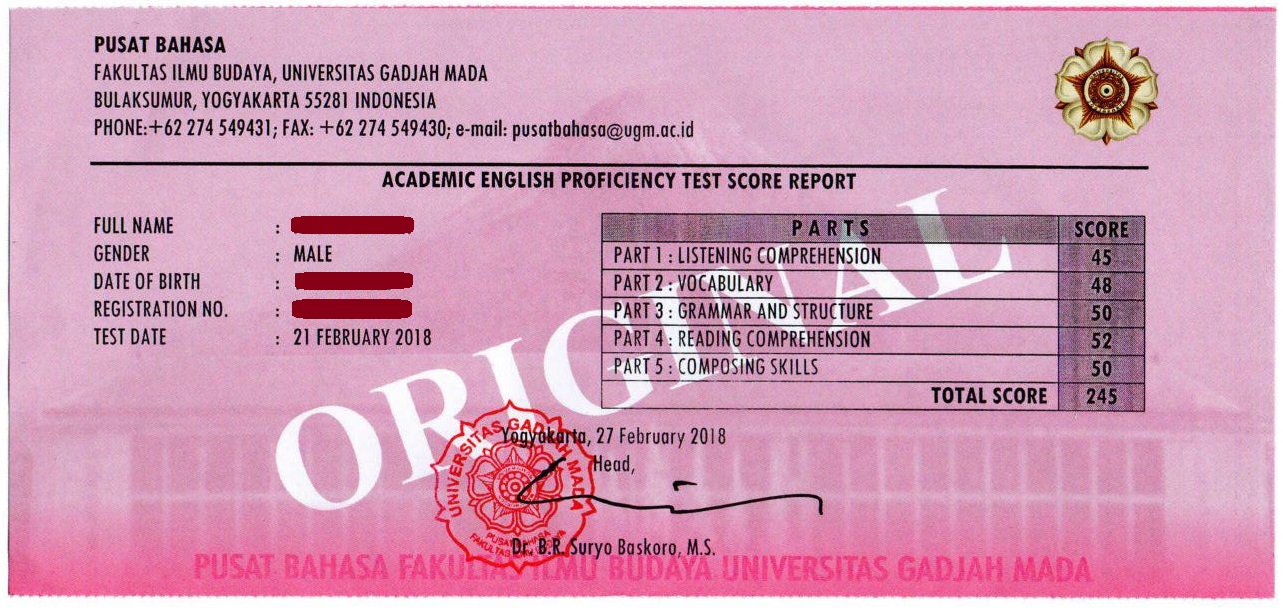
Affordable and convenient language certification from Duolingo. EPT™ (English Proficiency Test) adalah tes menyeluruh yang mengukur semua aspek dalam kemahiran berbahasa Inggris khususnya untuk keperluan akademis. Keterampilan berbahasa yang diuji meliputi mendengar, berbicara,membaca dan menulis.
Hangugeo neungnyeok siheomHangugŏ nŭngnyŏk sihŏmThe Test of Proficiency in Korean ( TOPIK) is a test for nonnative speakers of Korean. The test is offered six times annually (Jan, Apr, May, Jul, Oct, Nov) within Korea and less often to people studying Korean in other countries. The test is for individuals whose first language is not Korean and is taken by overseas ethnic Koreans, those wishing to study at a Korean university, and for those who want to be employed at Korean companies in and outside of Korea. TOPIK is administered by the National Institute for International Education (국립국제교육원, NIIED). Contents.History The test was first administered in 1997 and taken by 2,274 people. Initially the test was held only once a year. In 2009, 180,000 people took the test.
The Korean government introduced a law in 2007 that required who have no relatives in Korea to take the test so they could be entered in a lottery for.In 2012, more than 150,000 candidates took the TOPIK, and the total number of people who have taken the test since its date of inception surpassed 1 million. YearNumber of candidates012151,166Format Old format In previous years, the test was divided into four parts: vocabulary and grammar, writing, listening, and reading. Two versions of the test were offered: standard (S)-TOPIK and the business (B)-TOPIK.
There were three different levels of S-TOPIK: beginner (초급), intermediate (중급), and advanced (고급). Depending on the average score and minimum marks in each section it was possible to obtain grades 1-2 in beginner, 3-4 in intermediate and 5-6 in advanced S-TOPIK.
In B-TOPIK the scores in each section (out of 100) were added together to give a score out of 400. New format A new format of the TOPIK took effect from the 35th TOPIK test, held in July 2014. Instead of Beginner, Intermediate and Advanced level tests, there are now only two level tests- TOPIK I & TOPIK II. TOPIK I has sub levels 1 and 2 while TOPIK II has 4 levels from 3 to 6. Another important change is that now the TOPIK I has only two sections - Reading and Listening, instead of 4 sections in the old format.
TOPIK II has 3 sections - Reading, Listening and Writing. Validity The test results are valid for two years after the announcement of examination results. Grading TOPIK I is the basic level test containing two obtainable grades, while TOPIK II is the combined intermediate/advanced level with four obtainable grades. The evaluation is based on the total number of points earned.Examination LevelLevelLevelPass MarkEvaluation CriteriaTOPIK ILevel 1A1Over 80 pointsAble to carry out basic conversations related to daily survival skills such as self-introduction, purchasing, ordering food, etc., and to understand the contents related to personal and familiar subjects such as himself/herself, family, hobby, weather and the like.Able to create simple sentences based on about 800 basic vocabulary items and possess understanding of basic grammar. Able to understand and compose simple and useful sentences related to everyday life.Level 2A2Over 140 pointsAble to carry out simple conversations related to daily routines such as making phone calls and asking for favours, as well as using public facilities in daily life. The Chosun Ilbo. 17 September 2008.
Retrieved 3 December 2009. Kim Hong-jin (11 September 2009). The Chosun Ilbo. Retrieved 3 December 2009. Bae Ji-sook (12 April 2009). Retrieved 3 December 2009.
22 April 2007. Retrieved 3 December 2009. Retrieved 25 January 2013. Retrieved 3 December 2009.
^. Retrieved 30 January 2014. Won, Yunhee. Pusan National University. Retrieved November 19, 2017. Retrieved November 19, 2017. ^.
Retrieved 3 May 2015. 2011-09-27 at theExternal links. (in English) (in Korean). (in Korean).
When you take an English test, you get a score. Often you'll also get some indication of what that score means, expressed as an English level or label, for example 'beginner' or 'advanced'. There are many different English leveling systems in use around the world, and an even wider variety of English tests, which have implicit or explicit leveling systems built into their scoring. Some English levelling schemes are built in to a particular English test, while others are theoretical frameworks without any associated test. The most reliable way to find out your English level is to take a well-designed assessment test. There are many tests to choose from, but taking the EF SET is a good place to start. You can use your EF SET score as an English level certification on your CV and on LinkedIn.
The EF SET (50 min) is currently the only standardized English test that reliably measures all skill levels, beginner to proficient, in alignment with the internationally recognized standard, the. Other standardized English tests are able to assess some proficiency levels, but not the entire CEFR scale. Using the EF SET to track your English level over months or years gives you a standardized way to evaluate your own progress.English level certification is required in applying for many university programs and visas. In the job market, although there are rarely official requirements, certifying your English level makes you stand out from the crowd. But in a broader sense, measuring your English level reliably, and being able to track your level change over time, is important for any English learner – how else will you know if your English is improving? Converting from one English level to another. The English level system you use to describe your English skills is usually imposed on you from the outside.
English Proficiency Test Adalah

An employer, a school, a teacher, or an immigration authority asks you to take a particular English test, so you do, and then you describe your English level using that test's system. Depending on your goals and location, you are likely to be more familiar with one system of English levels than another.
Proficiency Test Sample
For example, if you're applying to university in the USA, you probably know what a TOEFL score of 100 means, whereas if you're trying to get a visa to move to the UK, you're more likely to be familiar with the CEFR level B1.